



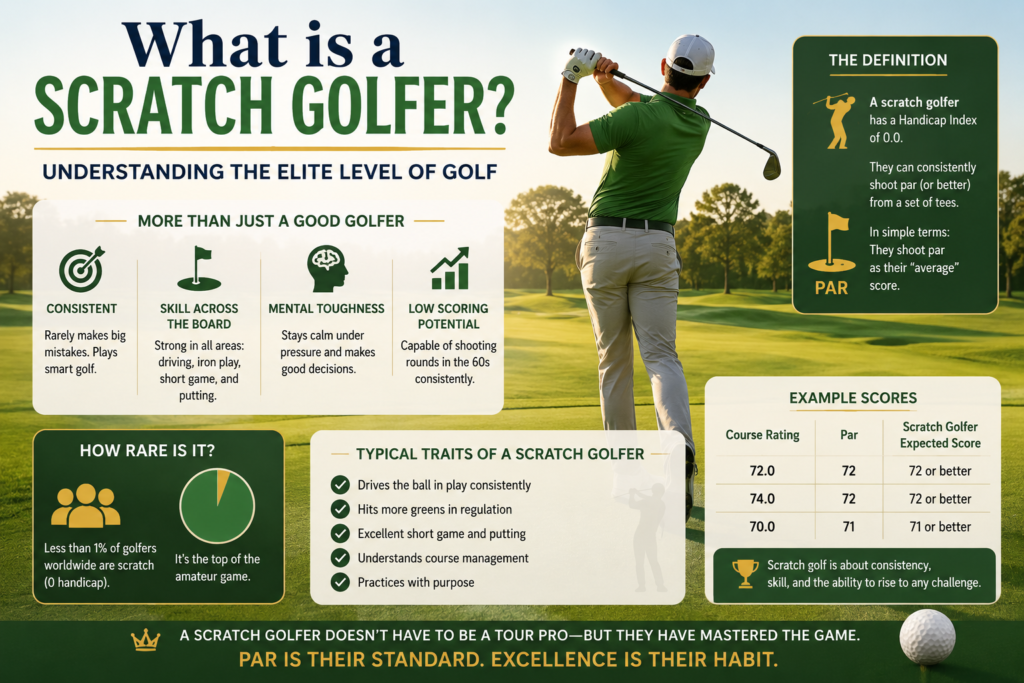
What is a scratch golfer? Understanding the elite level of golf
Introduction
The One-Sentence Definition
A scratch golfer is an amateur with a course handicap of zero who, according to the USGA definition and the World Handicap System (WHS), can play to the course rating on any rated golf course under normal conditions.
Key Elements in the Definition
A scratch golfer’s handicap index is 0.0, called a scratch handicap, and uses the golf handicap system managed by GHIN and the USGA. This means the player can score even par on courses of average difficulty, regardless of the slope rating or course rating. The course handicap reflects the player’s ability to play at par, while the handicap index is portable between courses with different ratings. Both male and female scratch golfers exist, and the requirements are the same for each.
Scoring Benchmarks and Comparisons
Typical scratch golfer stats include a driving distance over 250 yards, an average score close to par, and the ability to recover from mistakes efficiently. The percentage of scratch golfers is less than 2% of all players according to recent GHIN and USGA data. A scratch golfer is not a professional; scratch golfer vs pro reveals that pros often carry a plus handicap golfer status and average scores below par. Compared to a bogey golfer or single digit handicap player, a scratch golfer consistently posts even par rounds and meets strict scratch golfer requirements. Becoming a scratch golfer may take years of focused practice, with the journey often spanning a decade or longer.
Where the Term “Scratch” Comes From: A Short History
Origins of the Term “Scratch” in Golf
The word “scratch” has roots in several sports, but its use in golf started in the early 20th century. In older times, “scratch” meant starting at the same level—no extra strokes. This idea applied to golf, where a scratch golfer had no handicap advantage. The USGA definition labels a scratch golfer as someone who can play to a Course Handicap of zero on any rated course. The term became part of the game as golf needed a way to compare players fairly.
Early golf clubs needed a fair scoring system, especially as competitive golf grew in popularity. The idea of a scratch round, or playing even par, helped set benchmarks. The golf handicap system was born from the need to balance play between scratch golfers, bogey golfers, and everyone in between. A scratch golfer’s handicap remains at 0—also called a zero handicap golfer. Golf organizations worldwide adapted this term as part of the standardized handicap system.
Evolution of the Handicap System: USGA, GHIN, and WHS
As golf grew in the US, governing bodies like the USGA formalized the handicap index. The USGA handicap system relies on key stats: course rating and slope rating. These figures consider course difficulty and are essential to calculating a course handicap. The introduction of the GHIN system allowed players to track scores and maintain a consistent handicap across clubs. With the World Handicap System (WHS), golfers now have a universal way to compare abilities.
A scratch golfer’s requirements, based on WHS, include scoring at or near course rating on any layout. For example, a golfer with a scratch golfer handicap needs to shoot even par, regardless of the course. Scratch golfer stats, like average score and driving distance, are tracked to set clear benchmarks. Single digit handicap players or low handicap golfers aim to reach this elite level. The percentage of scratch golfers in the US is well below 2%, showing how rare this skill level is.
Comparison: Scratch Golfer vs Pro and Other Groups
A scratch golfer is not always a pro, but the difference can be subtle. Pros, often plus handicap golfers, play below par on tough courses. The average scratch golfer average score hovers around even par, while the scratch golfer driving distance is impressive but may not match tour pros. Female scratch golfer benchmarks mirror this standard, with slight adjustments for course rating.
Golfers often ask how long to become a scratch golfer. It requires years of practice and understanding the golf handicap system. The journey from bogey golfer to scratch golfer shows commitment and skill. By knowing the history of the term and its benchmarks, players can better target scratch round goals and understand the requirements that define this elite level of play.
Scratch Golfer Handicap Explained: Handicap Index, Course Handicap & Course Rating
What is a Scratch Golfer Handicap?
A scratch golfer is a player with a handicap index of 0.0. According to the USGA definition, a scratch golfer can play to par on any course, under normal conditions. This means they consistently shoot even par, known as being a par golfer. The term “scratch golfer handicap” is reserved for players who reach this zero handicap level. The average score for a scratch golfer is usually around par, while a bogey golfer will average higher scores.
The World Handicap System (WHS) and GHIN (Golf Handicap and Information Network) track handicap index. To calculate a scratch handicap, the golf handicap system considers scores from several recent rounds. These scores are measured against the course rating and slope rating to create a fair benchmark.
Understanding Handicap Index, Course Handicap, and Course Rating
A handicap index is a number that measures a golfer’s potential. It allows players of different abilities to compete on equal footing. The course handicap is determined using the handicap index, the course rating, and the slope rating. The course rating tells you the expected score for a scratch golfer, while slope rating reflects the course difficulty for a bogey golfer. Scratch golfer requirements include regularly posting scores at or near the course rating.
For example, a scratch golfer playing a par-72 course with a course rating of 72.0 and slope rating of 113 will have a course handicap of zero. A plus handicap golfer is better than scratch; their handicap index is below zero. Single digit handicap and low handicap golfers are skilled, but not at scratch level yet.
Scratch Golfer Stats and Benchmarks
Scratch golfer stats highlight the high level of play required. The percentage of scratch golfers is very low—less than 2% of all golfers reach this level. The scratch golfer driving distance averages about 250-270 yards for men, and 210-230 yards for a female scratch golfer. Scratch golfer average score is close to par. They consistently hit fairways, greens in regulation, and make very few double bogeys or worse.
Scratch golfer vs pro is an interesting comparison: pros play at an even higher level, often with plus handicaps. Becoming a scratch golfer takes years—how long to become a scratch golfer depends on talent and dedication, but most spend many years pursuing this goal. Scratch rounds require skill, focus, and course management. Low handicap golfer and single digit handicap players can use scratch golfer benchmarks as targets for improvement.
Call Today To Discuss
Your Golf Travel Plans!
From TPC Sawgrass to the rugged cliffs of Pebble Beach, we provide exclusive access to the legendary fairways you’ve always dreamed of playing.
833 271-5050How Rare Are Scratch Golfers? The Percentage, by the Numbers
Defining a Scratch Golfer and the Handicap System
To understand how rare a scratch golfer is, it’s important to clarify the definition. The USGA defines a scratch golfer as an amateur who can play to a Course Handicap of zero on any rated golf course. This means the player can shoot even par under normal playing conditions. The World Handicap System (WHS) and GHIN use a formula that considers slope rating and course rating to calculate a golfer’s handicap index. A zero handicap, or scratch handicap, means the player matches the expected score for a par golfer on any course.
The golf handicap system uses several benchmarks. A single digit handicap golfer is already considered skilled. Low handicap golfers are those with a handicap between 2 and 5. A scratch golfer handicap sits at zero, while a plus handicap golfer often shoots below par. Female scratch golfers follow the same USGA definition, though scoring can vary slightly with different course ratings.
Scratch Golfer Stats: Population, Scores, and Benchmarks
Scratch golfers are extremely rare in the golfing population. According to USGA handicap statistics, less than 2% of all golfers maintain a scratch handicap. The percentage of scratch golfers worldwide remains similar. Most golfers fall into the bogey golfer category (handicap around 18). Achieving a zero handicap or becoming a scratch golfer requires years of dedication and consistent play. The journey for how long to become a scratch golfer often takes a decade or more of focused practice.
Key scratch golfer stats offer insight into benchmarks:
| Category | Scratch Golfer | Bogey Golfer |
|---|---|---|
| Handicap Index | 0 (zero handicap) | ~18 |
| Average Score | Par (even par, 72) | ~90 |
| Driving Distance | 250-270 yards | 180-200 yards |
| GIR (Greens in Reg.) | 11-13 per round | 4-6 per round |
Scratch golfer requirements include strategic play, course management, and mental strength. The scratch golfer average score hovers at par on most courses. Comparing scratch golfer vs pro, professionals are plus handicap golfers who regularly shoot under par rounds in tournament play.
The Rarity and Prestige of a Scratch Round
Scratch rounds are celebrated in the golfing community. Completing a round at even par is a notable achievement, even for low handicap golfers. Female scratch golfers and male scratch golfers both face the same challenge of mastering the golf handicap system and meeting strict benchmarks. Slope rating and course rating ensure parity in measuring a scratch golfer on different courses.
Statistics from the USGA and GHIN show just how exclusive this group is. With only about 1-2% of golfers achieving scratch or better, the percentage of scratch golfers remains small. Many strive for a single digit handicap, but reaching the elite level of scratch golfer requirements sets a player apart as a master of the game.
Scratch Golfer Average Score: What They Really Shoot
Defining the Scratch Golfer: Benchmarks and Scoring
A scratch golfer is defined by the USGA handicap system as a player with a handicap index of 0.0. This golfer typically has a course handicap of zero and can play to the course rating on any golf course of average difficulty. The World Handicap System (WHS) uses both slope rating and course rating to calculate a golfer’s handicap index. A scratch golfer’s requirements include consistent scores at or near par, making them an even par or par golfer. While the USGA definition is clear, scratch golfer stats show that less than 2% of golfers ever reach this elite level – making it a rare achievement.
Scratch golfer average score often hovers around the course rating, which is usually close to par. For a typical course with a par of 72, a scratch golfer will likely shoot between 72 and 74. Scratch golfer stats reveal that scoring much lower often requires moving into the realm of a plus handicap golfer, which is even more exclusive. Female scratch golfers generally post similar scores, adjusted for course rating and yardage, with the same 0 handicap requirement.
How Scores Compare: Scratch Golfer vs Pro and the Rest
A true scratch golfer consistently shoots at or near par but is not a professional. The difference between a scratch golfer vs pro is significant: professionals often shoot several strokes under par on challenging setups. The scratch golfer average score, depending on conditions and pressure, may rise to 74 or 75, but remains impressively steady. Compared to a bogey golfer, who has a handicap around 18 and shoots about 90 on a par 72, the scratch golfer’s stats and benchmarks are exceptional.
Single digit and low handicap golfers, with indexes from 1 to 9, are also strong players but do not meet the scratch golfer requirements for a 0 handicap. Scratch golfer driving distance is often around 250-270 yards for men, a key part of their ability to reach greens in regulation. Female scratch golfers tend to average 210-230 yards off the tee. Scratch golfer stats demonstrate that accuracy, smart course management, and a reliable short game are as important as distance.
Tracking Progress: Golf Handicap System and Achieving Scratch
Becoming a scratch golfer is a long journey. According to GHIN records, the percentage of scratch golfers remains under 2% worldwide. The path to a scratch round involves mastering the golf handicap system, understanding how slope rating and course rating affect your scores, and tracking every round for handicap index updates. To maintain a scratch golfer handicap, players must post consistent rounds at or near the course rating, avoiding blow-up holes and showing mental resilience.
For those asking how long to become a scratch golfer, the answer varies. Most players spend years moving from bogey golfer to single digit handicap, then refining their game to reach scratch. Keeping a scratch handicap requires continued commitment, study of scratch golfer stats, and a relentless pursuit of improvement.
Scratch Golfer Driving Distance and Ball-Striking Benchmarks
Defining Scratch Golfer Stats and Requirements
A scratch golfer, according to the USGA definition, maintains a course handicap of zero. This means the player can expect to play to the course rating on any given set of tees. To achieve scratch golfer status, players must meet specific benchmarks in ball-striking, driving distance, and scoring. The World Handicap System (WHS) and GHIN track a golfer’s handicap index, factoring in slope rating and course rating to provide a standardized measurement. Scratch golfer stats show that only about 2% of golfers ever reach this level. The scratch golfer handicap remains at or near 0, while the average score for a scratch golfer consistently hovers around par. Scratch golfer requirements include a strong grasp of the golf handicap system and the ability to post scratch rounds across different courses and conditions.
Female scratch golfers have slightly different benchmarks, yet the skill required remains elite. For a female scratch golfer, the USGA defines a similar handicap index threshold. Both male and female scratch golfers demonstrate exceptional course management and consistency. The percentage of scratch golfers among all players stays very low, highlighting the difficulty of maintaining even par play.
Driving Distance Benchmarks for Scratch Golfers
Driving distance is a key component of scratch golfer stats. On average, a male scratch golfer drives the ball between 255 and 270 yards. Female scratch golfers average about 210 to 220 yards off the tee. While not always as long as plus handicap golfers or tour pros, scratch golfers combine distance with accuracy. The focus is not just raw distance, but reliable ball-striking and control. In the scratch golfer vs pro comparison, professionals tend to hit it farther, but scratch golfers must demonstrate a blend of distance and precision to meet their requirements.
Ball-striking for scratch golfers involves hitting a high percentage of greens in regulation. A scratch golfer typically hits 12-14 greens per round. They also keep their misses manageable, avoiding high numbers. Consistent iron play, wedge control, and smart club selection are signs of a low handicap golfer. Maintaining this level of performance across diverse course ratings and slope ratings is necessary for a true scratch handicap.
Comparison with Other Handicap Levels
A scratch golfer stands apart from single digit and bogey golfers. A single digit handicap golfer often scores a few over par and may lack the consistency of a scratch golfer. The average bogey golfer, with a handicap around 18, has different benchmarks entirely. The golf handicap system ensures that scratch round performance is recognized as exceptional. Scratch golfers must consistently manage risk, play to the strengths of their game, and avoid costly errors. The scratch golfer average score of “even par”—or even a bit under on easier courses—sets them apart.
Compared to plus handicap golfers, who carry a handicap below zero, a scratch golfer is highly skilled but not quite at the level of elite amateurs or professionals. The time frame for how long to become a scratch golfer varies, but it requires years of dedicated practice and an understanding of both the course and the game. The scratch golfer requirements outlined by the USGA and demonstrated through GHIN and WHS records show how challenging and rewarding it is to reach this elite status.
Scratch Golfer Requirements: The Complete Skills Profile
Defining the Scratch Golfer: Handicap, Ratings, and Benchmarks
What is a scratch golfer? According to the USGA definition, a scratch golfer is an amateur who can play to a handicap of zero on any rated course. This is called a scratch handicap or 0 handicap. The World Handicap System (WHS) and the USGA handicap system use metrics like course rating, slope rating, course handicap, and handicap index to standardize scoring. A scratch golfer handicap is benchmarked against scratch round performances.
To calculate a course handicap, the system considers both the course rating and slope rating. The scratch golfer’s average score matches the par of most courses. Typical scratch golfer stats show men scoring around even par, while a female scratch golfer may have a slightly higher average due to course setups. The GHIN system tracks scores and updates handicap indexes, providing a transparent record of scratch golfer requirements and progress.
Key Skills and Performance Metrics
A scratch golfer must master every part of the game. Scratch golfer driving distance averages 250-270 yards for men and 210-230 yards for women. Greens in regulation and up-and-down percentages are high. High-level course management skills separate a scratch golfer vs pro or a plus handicap golfer from a single digit handicap or bogey golfer.
To maintain a zero handicap, golfers must consistently shoot at or below par. Scratch golfer average score is close to course rating. Achieving this requires strong iron play, accurate driving, a reliable short game, and consistent putting. Mental strength, strategy, and the ability to avoid big numbers are crucial scratch golfer requirements.
The Path to Scratch: Time, Dedication, and Rarity
How long to become a scratch golfer? Most players need years of focused practice and play. Less than 2% of all golfers reach scratch status. The percentage of scratch golfers is low because it demands exceptional consistency, knowledge of the golf handicap system, and emotional discipline.
Scratch golfers regularly evaluate their stats and benchmarks. They learn from every scratch round and refine their technique. Compared to a low handicap golfer, scratch golfers have fewer blow-up holes, better course management, and more confidence under pressure. The journey is challenging, but meeting scratch golfer requirements marks the achievement of an elite level in golf.
Call Today To Discuss
Your Golf Travel Plans!
From TPC Sawgrass to the rugged cliffs of Pebble Beach, we provide exclusive access to the legendary fairways you’ve always dreamed of playing.
833 271-5050Scratch vs Bogey Golfer: The Two USGA Benchmarks
USGA Definition: What Is a Scratch Golfer vs. a Bogey Golfer?
The USGA uses two benchmarks to describe golfer skill: the scratch golfer and the bogey golfer. According to the USGA definition, a scratch golfer is an amateur with a zero handicap, or course handicap of zero, able to play to the course rating on any rated golf course. For example, a scratch golfer can expect to shoot even par, or close to it, on courses with different slope ratings and course ratings. In contrast, a bogey golfer is a player with a course handicap of about 20 for men and 24 for women. This means a bogey golfer averages a score near bogey, or one stroke over par, on each hole. The golf handicap system, now unified under the World Handicap System (WHS), uses these definitions to calculate a player’s handicap index.
Key Stats and Benchmarks: Scratch Golfer vs. Bogey Golfer
Scratch golfer stats help show the elite level required. A scratch golfer’s average score is close to par on rated courses, while a bogey golfer averages 18–24 strokes over par for a round. Scratch golfer driving distance often exceeds 250 yards, with accuracy as a strength. On the other hand, bogey golfers tend to have less distance and greater inconsistency. The percentage of scratch golfers among all players is very low—less than 2%. Achieving a scratch handicap takes years; most never reach it. Female scratch golfer requirements are similar, with a zero handicap expected from tees appropriate for their game. GHIN and the WHS track scores and handicap indexes, ensuring fair competition between scratch and bogey players.
| Benchmark | Scratch Golfer | Bogey Golfer |
|---|---|---|
| Handicap Index | 0 (Zero handicap) | 20 (Men), 24 (Women) |
| Average Score | Even par | 90–95 (Men), 100+ (Women) |
| Driving Distance | 250+ yards | 180–210 yards |
| Percentage of Players | <2% | ~20% |
Slope Rating, Course Rating, and Handicap Calculation
The World Handicap System uses slope rating and course rating to adjust every golfer’s score—whether a scratch round or a bogey round—for difficulty. Slope rating reflects how much harder a course plays for a bogey golfer compared to a scratch golfer. Course rating estimates what a scratch golfer would score under normal playing conditions. The GHIN system calculates a player’s handicap index from recent rounds, normalizing scores using course and slope ratings. This ensures a scratch golfer handicap means true par ability, while a bogey golfer’s handicap reflects typical performance above par. The golf handicap system enables fair play, letting low handicap golfers, single digit handicap players, and higher handicap golfers compete together.
Scratch vs Single-Digit, 10 and 20 Handicaps: How the Stats Compare
Understanding the Handicap Spectrum
The golf handicap system, overseen by the USGA and standardized through the World Handicap System (WHS), allows players at various skill levels to compete fairly. The course handicap reflects how many strokes a player receives based on the course rating and slope rating. A “scratch golfer” is defined by the USGA as someone with a course handicap of zero. This means they can expect to play to the course rating on any given course. In comparison, single digit handicap golfers have a handicap index between 1 and 9, while 10 and 20 handicaps represent advanced and intermediate players, respectively.
The percentage of scratch golfers is low—less than 2% of golfers reach this level. Most golfers fall into the 10 to 20 handicap range, which is considered average. Understanding what is a scratch golfer starts by comparing how these groups perform on the course, from scoring to skill execution.
Scoring, Driving Distance, and Benchmarks
Scratch golfers, often called even par or par golfers, consistently shoot at or below par. The scratch golfer average score hovers around 72 on championship courses. Scratch golfer stats show driving distances averaging 250-270 yards for men and about 210-230 yards for female scratch golfers. Single digit, 10, and 20 handicap golfers generally shoot higher scores:
| Handicap Level | Average Score | Avg. Driving Distance | Greens in Regulation (%) |
|---|---|---|---|
| Scratch (0) | 72-74 | 250-270 yds (M) | 65-70 |
| Single digit (1-9) | 76-82 | 230-250 yds | 45-55 |
| 10 Handicap | 83-85 | 210-230 yds | 35-45 |
| 20 Handicap | 90-95 | 180-200 yds | 20-30 |
Scratch round requirements go beyond scoring. These players excel in short game, course management, and avoiding double bogeys. A scratch golfer handicap is rare, while a plus handicap golfer plays better than scratch. In contrast, bogey golfers (around 18 handicap) typically shoot one over par per hole.
Skill Set and Progression
The GHIN and World Handicap System track each golfer’s handicap index, updating it as scores are posted. To become a scratch golfer, a player must consistently meet strict benchmarks, including maintaining a low scoring average and handling high slope rating courses. The journey from a 20 to a scratch handicap can take years. Many ask how long to become a scratch golfer—it often requires thousands of practice hours and competitive rounds. Emotional control, strategic decisions, and technical skills mark the difference between a scratch golfer vs pro or a low handicap golfer.
In summary, the difference between a scratch golfer and a 10 or 20 handicap golfer is significant in terms of stats, consistency, and mastery. Single digit and low handicap golfers are skilled, but reaching scratch golfer requirements means achieving elite status in the game.
Plus Handicap Golfer: The Tier Beyond Scratch
Defining the Plus Handicap Golfer
A plus handicap golfer operates at a level above the classic scratch golfer. While a scratch golfer is defined by the USGA as a player with a zero handicap, capable of shooting par on any golf course, a plus handicap golfer has a handicap index less than zero. This means they consistently shoot scores below par, even after accounting for course rating and slope rating adjustments. For example, if a player’s USGA handicap index is +2.0, their expected score is two strokes under par on a neutral course. The World Handicap System (WHS) and GHIN recognize these exceptional results in their calculations. While the percentage of scratch golfers is already low, plus handicap golfers represent only a fraction of this elite group.
The requirements for attaining a plus handicap go beyond simply avoiding bogeys. These golfers maintain scratch round consistency, regularly producing scores under par, or as even par, regardless of changing conditions. Both male and female scratch golfers who join the plus ranks show mastery not just of long drives but also of refined short games and strategic shot-making. Their scratch golfer stats, such as average driving distance and scoring average, often rival those of touring professionals.
Comparing Plus Handicap, Scratch, and Pro Golfers
What is a scratch golfer compared to a plus handicap golfer? Scratch golfers hold a 0 handicap, while plus players have negative numbers—an indicator of their ability to outperform par. These distinctions become clear in various golf handicap system records and tournament play. The average plus handicap golfer’s round often mirrors scores posted by lower-level professionals; both manage course management efficiently and limit mistakes. Yet, the consistency and pressure tolerance required for the professional tour still set pros apart.
Here is a comparative table for different golfer levels:
| Golfer Type | Handicap Index | Typical Score Relative to Par |
|---|---|---|
| Bogey Golfer | ~18 | +18 |
| Single Digit Handicap | 1-9 | +1 to +9 |
| Scratch Golfer | 0 | Even Par |
| Plus Handicap Golfer | <0 | Under Par |
| Touring Pro | -4 to -6 | -4 to -6 |
Scratch golfer vs pro debates often center on driving distance, average score, and pressure performance. A scratch golfer handicap or scratch handicap is impressive, but plus players demonstrate even greater mastery.
Achieving the Plus Handicap: Standards and Benchmarks
Becoming a plus handicap player takes even more time and dedication than reaching scratch status. While less than 2% of all golfers achieve a scratch handicap, only a tiny percentage of scratch golfers advance into plus territory. The minimum requirements include maintaining a scoring average consistently under par, as well as strong rankings in stats like greens in regulation, putting, and driving accuracy. Scratch golfer requirements are demanding, but plus players must excel in every golf skill area.
Female scratch golfers and low handicap golfers aiming for plus status need to focus on performance in every aspect of the game. The journey involves a deep understanding of the course rating, slope rating, and how to leverage the golf handicap system—WHS, GHIN, and USGA definitions all play a role in tracking progress. For those wondering how long to become a scratch golfer, the path can take years of disciplined practice, and the leap to plus status is even steeper. Golfers who reach this level set new benchmarks for the amateur game and often compete at the highest regional and national levels.
Scratch Golfer vs Professional Golfer: The Real Gap
Defining the Levels: Scratch vs Pro
A scratch golfer is defined by the USGA as a player who can play to a Course Handicap of zero on any rated course. This means shooting even par, or having a course handicap of 0, using the World Handicap System (WHS). The scratch golfer handicap is a significant milestone, but it is not the same as being a professional golfer. Pros play for a living and often have a plus handicap, meaning their handicap index is better than zero. While the scratch golfer average score hovers around par, professionals shoot several strokes lower, even on the most challenging layouts.
When comparing a scratch golfer vs pro, the gap is clear. A scratch golfer has mastered the basics of the game, including swing mechanics, short game, and mental focus. Professional golfers, however, excel in every benchmark: driving distance, consistency, and scoring under pressure. The average scratch golfer driving distance is about 250-270 yards. In contrast, PGA Tour pros average 295 yards or more. Female scratch golfers may drive 210-230 yards, while LPGA pros can exceed these numbers. The difference in driving and approach shot ability is significant.
Performance Benchmarks and Stats
Scratch golfer stats provide a baseline for elite amateur play. A scratch golfer shoots close to par, with a handicap index of 0.0 according to the GHIN and USGA definition. Most scratch rounds feature 11-13 greens in regulation, 30-32 putts, and few double bogeys. In contrast, pros typically hit even more greens, average fewer putts per round, and rarely miss up-and-downs around the green. Pros also score better in adverse conditions and under tournament pressure.
The percentage of scratch golfers is small—less than 2% of all golfers, compared to an even smaller percentage who make it to the professional ranks. The golf handicap system, including slope rating and course rating, helps illustrate why: the requirements for scratch status are tough, but for a pro, the bar climbs even higher. While a single digit handicap or low handicap golfer is already accomplished, the leap from scratch to pro remains vast. Most bogey golfers and aspiring even par players want to know how long to become a scratch golfer, yet even achieving a scratch handicap does not mean competing at the pro level.
Handicap Systems and Real-World Play
Understanding the difference between a scratch golfer and a professional golfer requires knowing the golf handicap system. The USGA and World Handicap System rely on course rating and slope rating to determine course handicap and handicap index. A zero handicap golfer can expect to match the course rating on a neutral course, but professionals regularly shoot lower than the course rating. The role of slope rating is to adjust for course difficulty, making a scratch round at a tough course more impressive.
In real-world play, professionals handle pressure differently, travel extensively, and compete against the best. The scratch golfer requirements are high, but the professional standard is in another league. The gap between a scratch golfer and a pro is about consistency, mindset, and exceptional skill—making the journey from scratch to pro one of golf’s toughest transitions.
Call Today To Discuss
Your Golf Travel Plans!
From TPC Sawgrass to the rugged cliffs of Pebble Beach, we provide exclusive access to the legendary fairways you’ve always dreamed of playing.
833 271-5050How to Become a Scratch Golfer: A Realistic Roadmap
Understanding the Scratch Golfer Standard
A scratch golfer, as defined by the USGA, has a course handicap of zero. This means scoring par or better on any rated course. The World Handicap System (WHS) and GHIN use slope rating and course rating to help calculate a scratch golfer’s handicap index. A scratch golfer handicap is set at 0, or even par, for each round played. To meet scratch golfer requirements, a player must consistently match or beat the course rating, not just the par. This is a demanding benchmark. Only about 2% of golfers reach this level, according to scratch golfer stats. The average score for a scratch golfer hovers at or below par. Female scratch golfers achieve similar consistency, though the path may differ in scratch golfer driving distance and physical benchmarks.
Key Skills and Benchmarks
Scratch golfer stats highlight the importance of strong fundamentals. These include hitting greens in regulation, solid short game, and strong putting. Scratch golfer driving distance is often 250+ yards for men and 210+ yards for women but strategy matters more than power. A scratch round isn’t built on birdies alone. Mistake minimization is crucial. Scratch golfer requirements demand exceptional course management. This means choosing safe shots and understanding risk. Scratch golfer vs pro: Pros may shoot lower scores, but scratch golfers are the top amateurs. Plus handicap golfers are even better, posting scores under par. In contrast, a bogey golfer is expected to shoot 18-over par. Single digit handicap golfers are on the way, but scratch is the next step. Scratch golfer average score and consistency set them apart from a low handicap golfer.
Steps to Achieve Scratch Status
- Track progress using the GHIN system and understand your handicap index.
- Practice key areas: driving accuracy, approach shots, chipping, and putting.
- Play different courses to get familiar with various slope ratings and course ratings.
- Study scratch golfer stats and benchmarks for both male and female scratch golfers.
- Work with a coach who understands the USGA definition and can guide you through the golf handicap system.
How long to become a scratch golfer? It often takes years of focused effort. Patience and disciplined practice are required. By mastering course management and refining skills, a golfer can reach the elite 0 handicap level. The path is tough, but the process builds both skill and character.
How Long Does It Take to Become a Scratch Golfer?
Understanding the Timeline
Many golfers ask, what is a scratch golfer and how long does it take to reach this level? The answer depends on several factors. Most people spend years learning the basics and building their skills. If you start playing golf as a child, it may take 10 or more years to become a scratch golfer. Adults who start later may take longer because they have less time to practice.
A scratch golfer is someone who has a Course Handicap of zero. This means they can shoot par or better on a regular basis. Only about 2 out of every 100 golfers reach this level. It takes a lot of practice, patience, and commitment.
Factors That Affect Your Progress
Some key things can speed up or slow down how quickly you can become a scratch golfer. These include:
- How often you practice and play
- The quality of your coaching or golf lessons
- Your physical fitness and health
- How much time you can spend on the course
- Your mental focus and ability to handle stress
People who practice daily and have good coaching may improve faster. Playing on challenging courses like Astor Creek Country Club can also help you get better. The best scratch golfers work on their short game, learn how to recover from mistakes, and stay calm under pressure.
Typical Paths to Scratch Golf
Most players follow a similar journey to become a scratch golfer. A common path looks like this:
| Stage | Skill Level | Time Spent |
|---|---|---|
| Beginner | Learning basics | 1-3 years |
| Intermediate | Breaking 90 | 2-4 years |
| Advanced | Breaking 80 | 2-3 years |
| Scratch | Par or better | 1+ years |
This table is only a guide. Each person’s journey is different. Some may progress faster, while others take more time. But knowing what is a scratch golfer and setting small goals can help you stay on track. Hard work and the right support are key to reaching this elite level.
How to Get a Handicap Index and Track Your Progress (GHIN & WHS)
Understanding the Handicap System
To answer “what is a scratch golfer,” it helps to know how the handicap system works. A handicap index shows your golfing ability compared to par. This number helps golfers of different skills play together fairly. The World Handicap System (WHS) is used worldwide to make scores easier to compare. The system uses your best scores and adjusts for course difficulty. A scratch golfer has a handicap index of zero. This means they play at par on any course.
The GHIN system (Golf Handicap and Information Network) makes it simple to track your handicap index. GHIN is run by the USGA. Many golf clubs, including Astor Creek Country Club, use GHIN to manage member handicaps. Signing up for GHIN is the first step for anyone who wants to track progress toward becoming a scratch golfer.
Getting Your Handicap Index
To get started, join a golf club with WHS and GHIN access. You can also join online if you do not belong to a club. Next, play and post scores for at least three 18-hole rounds or six 9-hole rounds. GHIN will use your scores and the course rating to give you a handicap index. Posting more scores helps make your index more accurate.
Steps to get a handicap index:
- Join a club with GHIN access
- Play three 18-hole or six 9-hole rounds
- Post all scores to GHIN
- Check your handicap index after scores are posted
Once you have a handicap index, track your scores often. To answer “what is a scratch golfer,” remember that you need to get your index to zero. Every time you play, enter your score into GHIN. This lets you see progress and areas for improvement.
Tracking Your Progress and Setting Goals
Use your GHIN account to follow your golf stats. The system shows trends, best rounds, and areas where you lose strokes. Set small goals as you work toward scratch golfer level. For example, aim to lower your handicap index by one point each season.
A sample progress table:
| Month | Handicap Index |
|---|---|
| March | 10.5 |
| June | 8.2 |
| August | 6.0 |
| November | 3.8 |
Remember, becoming a scratch golfer takes time and effort. Tracking your handicap lets you see how close you are to playing at par. Stay focused on improvement, and use your GHIN account as a guide.
Scratch Golfer FAQs
What is a scratch golfer?
A scratch golfer is someone who has a Course Handicap of zero. This means they can play to par on any course. They are not professional players, but their skills are very high. Scratch golfers can compete in amateur events and often shoot scores close to par every round.
Most golfers are not scratch golfers. Only about 2% of people who play golf reach this level. It takes a lot of practice and effort to become a scratch golfer. You have to be very good at all parts of the game, such as driving, putting, and making smart choices on the course.
How does someone become a scratch golfer?
To become a scratch golfer, you need to master the basics of golf. This means learning how to hit the ball straight and far. You must also work on your short game, like chipping and putting. Many scratch golfers practice every day. They keep working to fix mistakes and improve their scores.
Fitness is important too. Scratch golfers keep their bodies in good shape to avoid injuries. They also practice how to handle pressure and stay calm during hard shots. Many scratch golfers take lessons from golf teachers, like the PGA professionals at Astor Creek Country Club.
What makes scratch golfers different from other players?
Scratch golfers are great at managing the course. They know how to pick safe shots and avoid big mistakes. They try to hit the green in as few shots as possible. Their short games help them recover if their first shots are not perfect.
Scratch golfers also have strong mindsets. They do not give up if a shot goes wrong. Instead, they stay positive and focus on the next shot. They play with a plan and do not let emotions control their game. This makes them more consistent than most players.
| Scratch Golfer Skills | Other Players |
|---|---|
| Hits most greens in regulation | Misses more greens |
| Recovers well from mistakes | Struggles to recover |
| Makes smart course choices | Takes more risky shots |
| Stays calm under pressure | Gets upset more easily |
Call Today To Discuss
Your Golf Travel Plans!
From TPC Sawgrass to the rugged cliffs of Pebble Beach, we provide exclusive access to the legendary fairways you’ve always dreamed of playing.
833 271-5050 Dealing with Slow Golf Play: Strategies for Enjoying Your Round
Previous
How Many Clubs in a Golf Bag
Next
Dealing with Slow Golf Play: Strategies for Enjoying Your Round
Previous
How Many Clubs in a Golf Bag
Next 